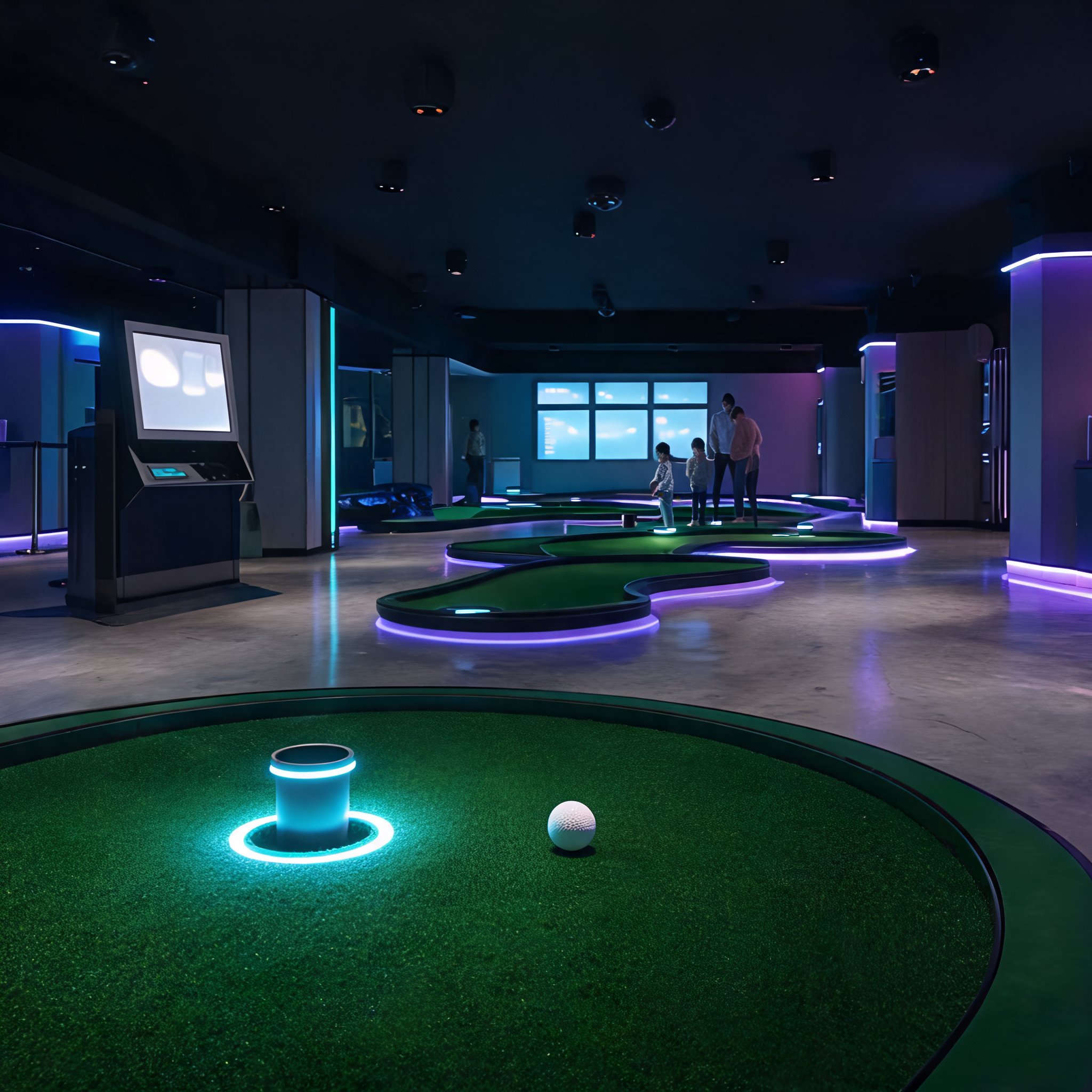
Holovis is positioning its 360Golf brand as more than a technology-enhanced mini golf course. The company describes it as a connected game platform: a familiar putting experience supported by automated scoring, gamified challenges and an analytics layer intended to help operators run venues, extend dwell time and generate secondary spending. The proposition matters because competitive socialising is crowded, and mini golf is already widely understood. 360Golf's argument is that familiarity lowers the barrier to play while technology adds repeatability and operational control.
The core of the system is automated scoring. Smart balls, tees and cups work with Holovis' HoloTrac scoring system, removing paper scorecards and acting as a referee when competition is close. Visitors can register, collect an assigned smart ball and begin playing with limited explanation or staff involvement. That simplicity is central to the product's positioning: the technology is meant to feel effortless even though it sits beneath the game.
Gamification built on a simple game
On top of automated scoring, 360Golf layers a set of game mechanics. SuperShots offer alternative ways to score, while Triumphs present awards and unlock new challenges. Bonuses, on-course games, player accounts, achievements, leaderboards and video celebrations give players reasons to compete, compare results and return. Holovis business development director Matt Dobbs says the aim is to create more reason to compete, celebrate and compare scores at the end of a game, and therefore more reason to revisit.
These features also shape the visitor profile. Stuart Edgington, global director of business development, argues that mini golf's base recognition allows 360Golf to appeal to families, competitive-socialising young adults and corporate groups. That intergenerational range is valuable to operators seeking an anchor attraction rather than a single-demographic activity. The claim is commercially plausible, but the published material does not provide independent evidence on how much the gamified layer changes repeat visitation or spend; those outcomes remain operator- and venue-dependent.
Data, throughput and secondary spend
The platform's data layer is DeepSmarts, an AI engine that supplies operators with analytics. Holovis says the system can support decisions on venue operations, dwell time and food-and-beverage revenue. It can also be used to identify quieter periods and target promotions, or to understand how players interact with the course. For maintenance, DeepSmarts can help engineers diagnose problems remotely and review incidents.
360Golf is designed for a high-throughput, low-friction model. Holovis cites capacity of up to 80 people per hour per course. A kiosk-led check-in and automatic scoring allow staff to concentrate on guest management and food and beverage service rather than explaining rules or calculating scores. Dobbs links happy guests to higher spending, but the stronger factual point is operational: automation reduces some staff tasks and creates more opportunity to serve guests. The revenue effect will depend on pricing, dwell time, venue mix and how well operators use the data.
Flexible formats, different constraints
The offer is deliberately modular. Operators can choose a technology-only retrofit for an existing mini golf attraction, a set of catalogue holes, or a fully customised course. Timelines reflect that range: Holovis says technology-only deployments take about six to eight weeks, catalogue holes can be installed and ready to play in eight to 12 weeks, and custom courses can take upwards of six months.
This flexibility allows 360Golf to fit very different sites. At one end are smaller entertainment venues that may use a more cost-effective physical design while retaining the same scoring and replayability. At the other are large multi-site operators that need consistency across locations. Edgington says the underlying technology lets clients vary theming, layout or branding while keeping a common operating platform. Saudi Entertainment Ventures is cited as a multi-site operator example, and Super Social in Leopardstown, Ireland, includes 12 holes from a sports-themed package.
Customisation also has to respond to physical conditions. Norwegian Cruise Line's Tee Time installations use marine-grade, waterproof equipment, including rugged cups and tees and specialist screens, so the same play pattern can work at sea. Holovis has delivered four Norwegian Cruise Line installations under the Tee Time brand. Netflix House's Top 9 course is a fully custom, IP-led project with unique hole designs and interactive elements themed around properties including One Piece, Squid Game and Floor is Lava. These examples show that the platform is not a single fixed product; the course, theming and hardware are adapted to the client and site.
What the cases show — and what they do not
The most concrete operating example in the article is Butlin's PLAYXPERIENCE indoor activity centre in Bognor Regis, a £15m project that opened in 2024. It contains three nine-hole 360Golf courses: a neon-glow course, a Las Vegas-themed course and a wheelchair-accessible music-themed course. Dobbs says the venue has reached 5,000 players in a busy week and grossed around £40,000 per week. These are client-reported performance figures, not independently audited results, and they should be read alongside the venue's broader leisure offer and location.
The Butlin's project also illustrates inclusive design. Holovis says it considered right- and left-handed play, putter sizes for taller guests, wheelchair access with a drop-down top cap, tee placement close to the edge for players who cannot enter the course, and spacing between holes to reduce overcrowding and safety hazards. Such details are easy to overlook in a technology-led attraction, but they affect how many people can actually play and how smoothly a venue operates.
Scaling, adjacent sports and market limits
360Golf is also being positioned for repeat visits across multi-site operations. Edgington argues that multi-site operators such as SEVEN and Super Social want consistent, replayable formats, while smaller operators can start with a simpler course and grow into a chain. The company is working on an integration with Roxy Leisure to add stroke-counting technology to crazy pool tables, and it wants to apply its technology to other sports. That expansion is a stated ambition and work in progress, not a proven second market.
Holovis is also candid about the competitive-socialising cycle. Edgington says the sector will eventually reach peak saturation and that 360Golf is looking at adjacent markets. That does not undermine the near-term opportunity, but it frames the product as an operating platform that can be adapted, rather than a single themed course. The company will exhibit at the Land Leisure & Tourism Show in Birmingham on 4–5 November and at IAAPA Expo in Orlando on 16–20 November, with a playable demonstration available at its Orlando office.
For operators, the key questions are practical: the venue's restrictions, the target audience, the desired mix of catalogue and custom design, and the commercial model around throughput, dwell time and food and beverage. 360Golf's proposition is a turnkey combination of course, scoring hardware, game software and analytics. Its strength is that it builds on a familiar activity; its limits are that the commercial results still depend on execution, location and the operator's ability to convert play into repeat visits and secondary spend.