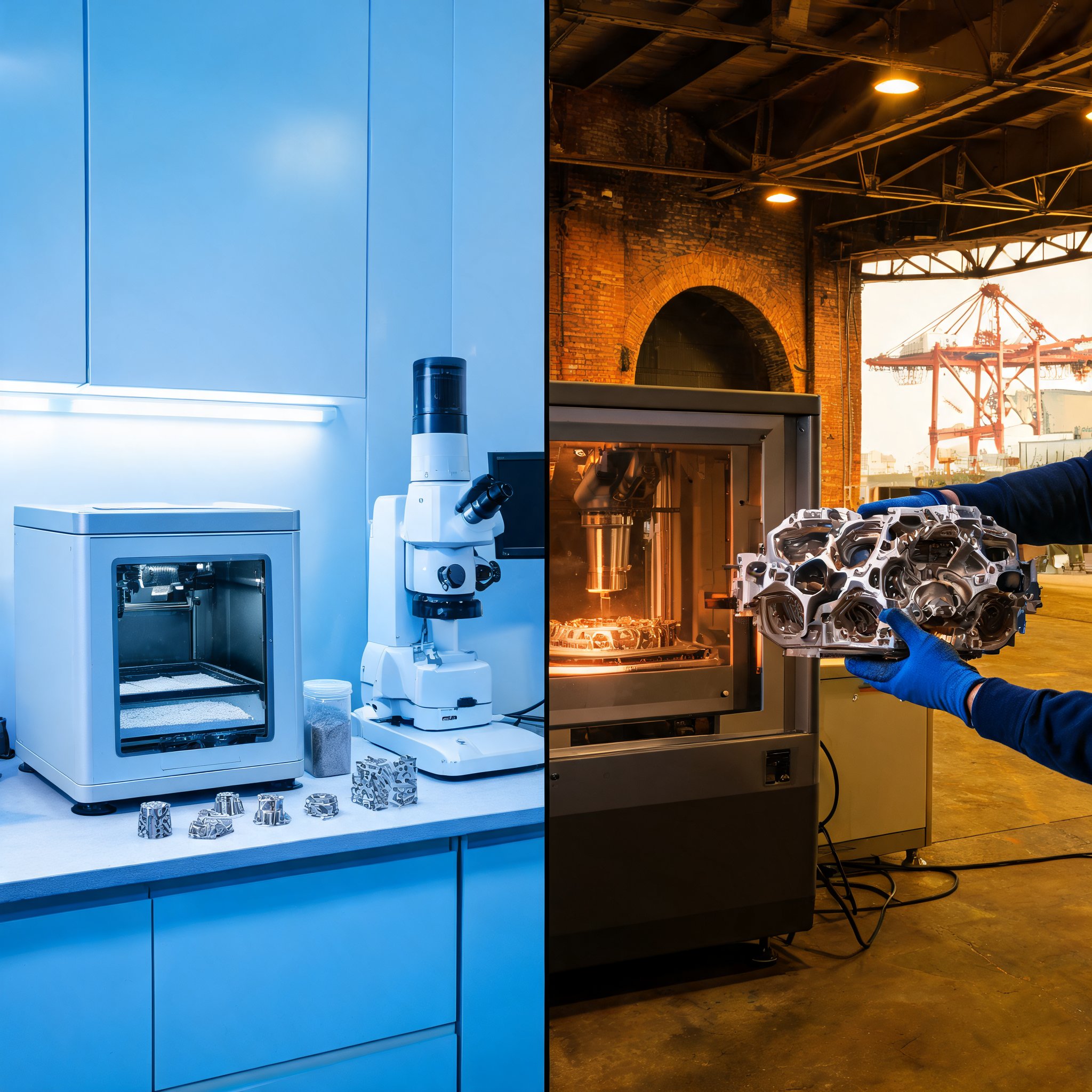
Britain helped pioneer industrial mass production and remains a centre of additive manufacturing research. Ahead of Formnext 2026 in Frankfurt, where the UK is partner country from 17 to 20 November, the central question is less whether British engineers can invent a process than whether customers will use it to make parts in Britain, repeatedly and at volume.
Research output is easier to count than production
The European Patent Office counted 1,925 international patent families in additive manufacturing originating in the UK between 2001 and 2020, close to France’s 1,938. Additive Manufacturing UK’s 2026 annual plan put the UK market at £515m to £740m in 2024, or 3% to 4.3% of the global total. The range reflects disagreement between estimates. A patent family records an attempt to protect an invention; a market estimate can include machines made overseas. Neither shows what share of production takes place in Britain.
Craig Pyser, chair of AMUK and chief executive of AMufacture, considers Britain’s share respectable for the size of its economy. He also recognises the historical complaint that British engineers invent things others sell more effectively. His focus is on what gives a customer a commercial reason to manufacture in Britain. For some buyers, being able to visit the factory, establish where a part came from and obtain a replacement quickly already does.
A thin installed base slows learning and hiring
Will Richardson, chief executive of Wayland Additive, points to metallurgy and materials science at Sheffield, Birmingham, Cambridge and Oxford, and to the Henry Royce Institute’s links across institutions. Wayland grew out of a team with electron-beam experience in semiconductors. In October, a Calibur3 metal system left its Huddersfield facility for the University of Innsbruck, where researchers plan to study difficult materials, including those for high temperatures. Britain built and exported the machine; some knowledge of what can be done with it will accumulate in Austria.
Richardson argues that firms do not become good at production unless they actually do it. He points to Britain’s limited installed base of industrial equipment and, in some markets, a shortage of major customers willing to put work through it. The effect appears in recruitment: a CNC machinist can learn to run an additive system, but regions with several factories can supply people who have already prepared builds and kept machines productive. With a small base, each company must train more itself. Renishaw’s Ben Deary and Ed Littlewood describe a related problem when production returns after years overseas: a former component or service supplier may have disappeared. Apex Additive Technologies helps customers rebuild such expertise by developing process parameters and proving a process before production moves in-house.
Qualification costs land on the order winner
Jason Hutt, managing director of Fastech, summarises the incumbent advantage: casting is already approved. An additively manufactured replacement may perform well in material tests and still need evidence specific to the equipment, process, grade and customer. A second buyer may require much of the work again, and the bill must come out of orders eventually won. The arithmetic for fifty parts differs from that for five thousand. The £38m Airbus-led DECSAM programme is one attempt to share that cost in civil aerospace, bringing Renishaw, GKN Aerospace, Apex, the Manufacturing Technology Centre and others together on demonstrators and qualification guidance; a production contract remains a further buyer decision.
Funding backs projects; sales need support
Jake Hand, co-founder of Exeter-based Rapid Fusion, says the large-format additive manufacturing business is profitable without R&D funding. Innovate UK support has allowed it to develop its own technology, work with partners and share costs it would otherwise carry alone. His criticism concerns the point at which a project succeeds: in his view, funders back a project, not a business. The award buys engineering time for a defined problem. Afterward, a customer asks whether the machine can make a particular mould, who will train the operator and what happens if a job stops halfway. Answering those questions for one sale can take months.
Innovate UK guidance allows later-stage work such as customer validation, initial tooling and production preparation, but general business costs fall outside an eligible project. That leaves a small firm choosing between an engineer to finish development and someone to find and support first customers, while needing to pay both. Pyser calls the application process excruciatingly difficult and would like assessors to visit screened businesses. Hand counters that some bids are poor and that successful delivery should count in an applicant’s favour. Kingston University shows what a customer reference can do: after a graduate introduced Rapid Fusion to his former department, the university installed a £450,000 Zeus robotic cell that combines large-format printing with CNC milling for in-house work, industrial partners and teaching.
University equity and the first investor
John Robinson, additive manufacturing research commercialisation manager at the University of Wolverhampton, incorporated a company in May 2017 that funded his PhD. In 2024 he and the university filed several patent applications together. He recalls the former technology transfer office wanting 75% of the company; more recent discussions with the enterprise team concerned a potential 10% stake. Both were proposals, but the first would have left a founder with a quarter of the equity before outside investment and later dilution. The Royal Academy of Engineering and Dealroom found that, among UK deep-tech hardware spin-outs in their sample, the average non-cash stake taken by universities fell from 25% in 2015–19 to 14% in 2024–25, with 2025 data partial.
Louis Masters has passed an earlier threshold. Hydra Manufacturing, a University of Leeds spin-out developing equipment for technical ceramics, announced £320,000 in equity investment led by SFC Capital in March; including earlier grants, it had secured about £577,000. Masters was considering raising around £1m or more. He understands why investors want to see two more installations: a customer willing to put a machine on its factory floor sends a stronger signal than an encouraging email. But developing the equipment and winning those customers consumes some of the capital he is seeking.
Demand signals and public procurement
Jason Bowes, chief operating officer of CloudNC, told a Manufacturing Technologies Association briefing at the House of Lords on 12 November that it is far easier to sell the company’s AI-assisted CNC programming technology in the US than in Britain. Hand also finds American buyers more willing to reinvest after a good year, while a cautious purchasing manager with an uncertain order book must cover the cost of existing machines.
Pyser estimates that 95% to 98% of AMufacture’s work is now production. Defence has become its largest sector, with marine and automotive also significant. Some defence customers revise designs every six to eight weeks, so a local manufacturer able to take a revised file and deliver the next batch can win repeat orders while the product keeps changing. Customers also bring requirements for traceability, integration and support. One customer took production in-house with AMufacture’s help, kept ordering, then sold the printer back two years later after software, staff and post-processing made the operation more costly than expected. By the count of firms operating printers that looks like a retreat; by the location of production, the work stayed in Britain with a specialist able to spread costs.
James Selka, chief executive of the MTA, told the Lords briefing that investment was poised to enter British manufacturing but needed a proper demand signal and co-investment from government; he put energy prices first among immediate obstacles. Lord Harrington of Watford, chair of Make UK, recalled that aerospace and life sciences had companies able to put substantial sums alongside public money, while some businesses government wanted to encourage could scarcely afford their share. He had chaired GeoPura, a hydrogen power business that tried to raise further capital in Britain and was sold to Canada’s Ballard Power Systems for £275m upfront in August. Added Scientific also separates a commercially established single-material process from multifunctional devices that combine several materials in one build; the first may need a buyer willing to specify and accept a part, while the second may still need research funding.
Public procurement is one lever. In 2025 the UK Atomic Energy Authority commissioned two additive systems at its Central Support Facility: a Freemelt electron-beam machine for tungsten work and a Nikon SLM laser system supplied by Kingsbury Machine Tools with support from Additure. The order gave a British public institution access to equipment made by international manufacturers. In separate fusion maintenance projects, UKAEA reports that British participants including Laser Additive Solutions, The Welding Institute and WAAM3D contributed to inspection and repair work. A UK laboratory can learn on an imported machine; a British machine builder needs to know when the next equipment specification will be drawn up, and a repair specialist whether development leads to a maintenance contract.
UKAEA publishes a quarterly procurement pipeline that separates possibilities over one to five years, pre-commercial work and confirmed requirements expected to go to tender. That helps a small manufacturer decide whether to send an engineer, bid or make a case to its board. Even a confirmed tender is far from a repeat order.
Pyser has a simple test for Britain’s appearance at Formnext: an overseas company choosing a European base and establishing it in Britain would count. Smaller questions will be answerable in a year. Did a customer who saw a British-built machine in Frankfurt order one? Did the first installation lead to a second? Brunel’s block-making machines got their answer in May 1803, when the Admiralty ordered another set for smaller blocks. The modern equivalent is to ask exhibitors who their next customer was.