Professional refrigeration is being reshaped by three pressures: the need to protect food safety, the push to cut energy use and the arrival of stricter European rules. In that setting, blast chillers are no longer treated as a niche appliance for specialist kitchens. They are increasingly presented as part of the core infrastructure for process control, food quality and more efficient buildings.
The basic function is rapid cooling. By circulating cold air intensively around food, a blast chiller can bring a product from more than 70°C to below 3°C in as little as 90 minutes. The article says the benefits go beyond compliance: faster cooling limits bacterial growth, extends shelf life and helps preserve texture, moisture, aroma and nutritional value. It can also improve production planning and reduce waste in hotels, hospitals, catering operations and food-processing plants.
Rapid cooling as a microbiological barrier
After cooking, food passes through a critical temperature range. Between roughly 63°C and 4°C, microorganisms can multiply quickly, which is why reducing time in that “danger zone” is a central principle of HACCP. Blast chillers are designed to shorten that window through forced cold-air circulation, supporting food safety and product quality at the same time.
Airflow, not just the refrigeration circuit
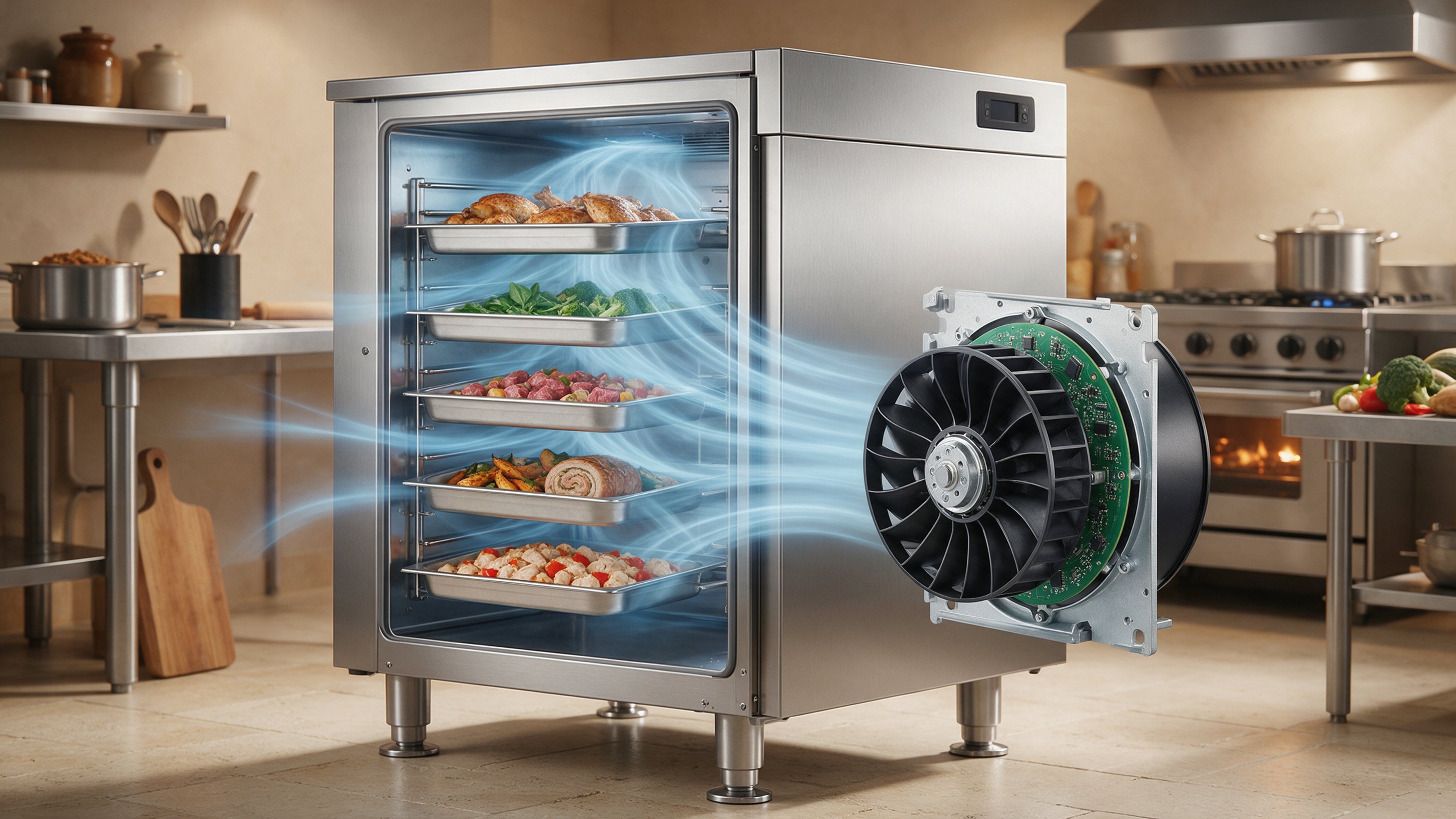
Performance is often associated with the compressor or evaporator, but the article argues that airflow distribution is decisive. Heat transfer works properly only when cold air reaches the whole load evenly. Slow-moving air or turbulence can leave parts of the product cooling more slowly, creating temperature differences that affect safety, cooling time and final quality.
That makes the fan a strategic component. EC, or electronically commutated, motors offer high electrical efficiency and continuous speed control, allowing airflow to be matched to each cooling stage. Combined with biomimetic impeller designs and composite materials, they can deliver more uniform cold-air distribution and lower energy use. The article also notes lower noise, less heat generation, reduced mechanical stress and longer service life, while saying such designs can replace some external controllers and increase room for food in the chiller.
Digital monitoring and building integration
Modern blast chillers can select programs by food type, track temperatures through probes and record the process for traceability. That record is useful during food-safety audits and supports HACCP compliance. Open protocols such as Modbus allow units to connect with kitchen infrastructure and building management systems, enabling remote monitoring and predictive maintenance. Continuous analysis of temperature, fan speed, operating hours and energy use can reveal deviations before they become failures, the article says.
Ecodesign moves beyond energy use
The European Union’s efficiency and carbon-reduction goals are driving a revision of rules for energy-related products. The Ecodesign framework is expanding from energy performance to durability, repairability, digitalization and system-level efficiency, with the Ecodesign for Sustainable Products Regulation marking a turning point. Although many measures will be phased in, the 2026 horizon is already influencing equipment and engineering decisions.
As a result, performance gains will not come only from the refrigeration circuit. Motors, fans, heat exchangers and electronic controls will all matter in meeting market expectations.
New roles for manufacturers and installers
Manufacturers are under pressure to keep investing in equipment that can meet tighter rules. Installers, meanwhile, need more knowledge of electronics, connectivity and control systems, because customers are asking for lower operating costs and higher reliability as well as cooling capacity. Intelligent components and predictive maintenance could position installation professionals as technology advisers across the equipment lifecycle.
The article cites ZIEHL-ABEGG as an example of this trend, describing its EC axial fans for commercial refrigeration and food service as combining efficient motors, aerodynamic design, low noise and open-protocol communication. The broader point is that a blast chiller’s efficiency depends on the combined performance of its parts, not a single component.
Food safety remains the primary objective. But meeting it increasingly requires an integrated approach in which airflow, energy efficiency, digitalization and sustainability are designed together. The next generation of professional refrigeration equipment will be judged not only on how quickly it produces cold, but on how little energy it uses, how well it connects and how flexibly it responds to emerging regulatory and environmental demands.