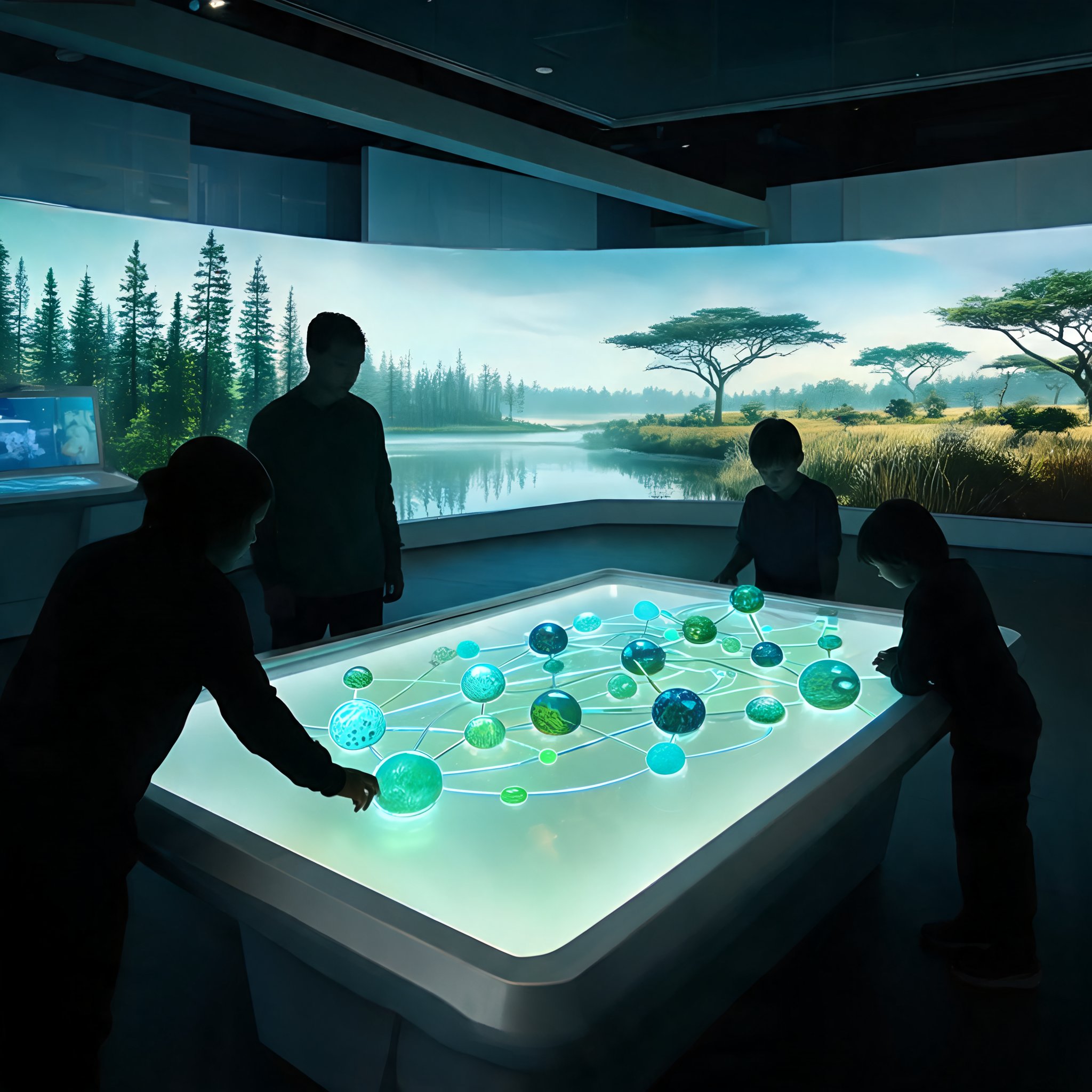
EcoWeb, an interactive ecological experience developed by Lutra Interactive AB, is designed to let visitors build and alter ecosystems and watch the consequences move through a food web. By adding or removing species, users can see how a change may cascade beyond the species they touched: removing a predator may affect herbivores and plants, while losing one species may have unexpected effects elsewhere in the network.
The project starts from a simple point: biodiversity is more than the number of species present. It is also the web of interactions that connects them. EcoWeb aims to make those connections, particularly indirect effects that are hard to show through conventional exhibits, diagrams or lists of threatened species, visible and interactive.
Built on ecological data
According to Lutra Interactive AB, EcoWeb combines ecological science, dynamic simulation and playful interaction. It uses empirical food-web data drawn from published ecological research, systematic literature reviews and species occurrence data, rather than simplified or fictional ecosystems. Its model includes both bottom-up and top-down effects, so changes can propagate through the network instead of affecting only directly connected species.
Visitors meet the complexity in stages. They begin with simple three-species food chains and explore what happens when species are added or removed. They then move on to larger food webs and different types and strengths of ecological interactions, before reaching complete networks with more than 100 species and over 1,000 interactions. Visitors can select individual species to reveal their connections, explore threatened species, and in the Swedish forest ecosystem move from recently cleared to old-growth forest to see how biodiversity and the network change.
Four ecosystems, one framework
EcoWeb currently covers four contrasting ecosystems: the Serengeti savanna, the Swedish boreal forest, an agricultural landscape and Lake Bolmen, one of Sweden’s largest lakes. The same underlying approach can be applied across them while retaining locally relevant species, data and environmental challenges.
The experience was designed in collaboration with scientists and educators and has moved beyond prototype into real-world use. It has been installed as a touchscreen experience at Swedish science centres including Universeum in Gothenburg, Curiosum in Umeå and Visualization Center C in Norrköping, and is also accessible through the web for WWF Sweden. Observations from these installations show visitors spending time exploring species and their connections, according to the company. Use with school groups has generated discussion and reasoning about extinction, indirect effects and trophic cascades.
Sustainability through participation
EcoWeb is positioned in the Sustainability category because it addresses biodiversity loss, which the company describes as one of the defining sustainability challenges of the time. Protecting biodiversity, it argues, requires more than knowing that species are disappearing; it requires understanding why those species matter and how ecosystems depend on the relationships between them.
Rather than simply telling visitors that biodiversity is important, EcoWeb lets them experiment with ecosystems themselves. In doing so, it aims to turn complex sustainability science into something tangible, memorable and engaging, creating a bridge between ecological research, public understanding and greater awareness of the consequences of human impact on nature.