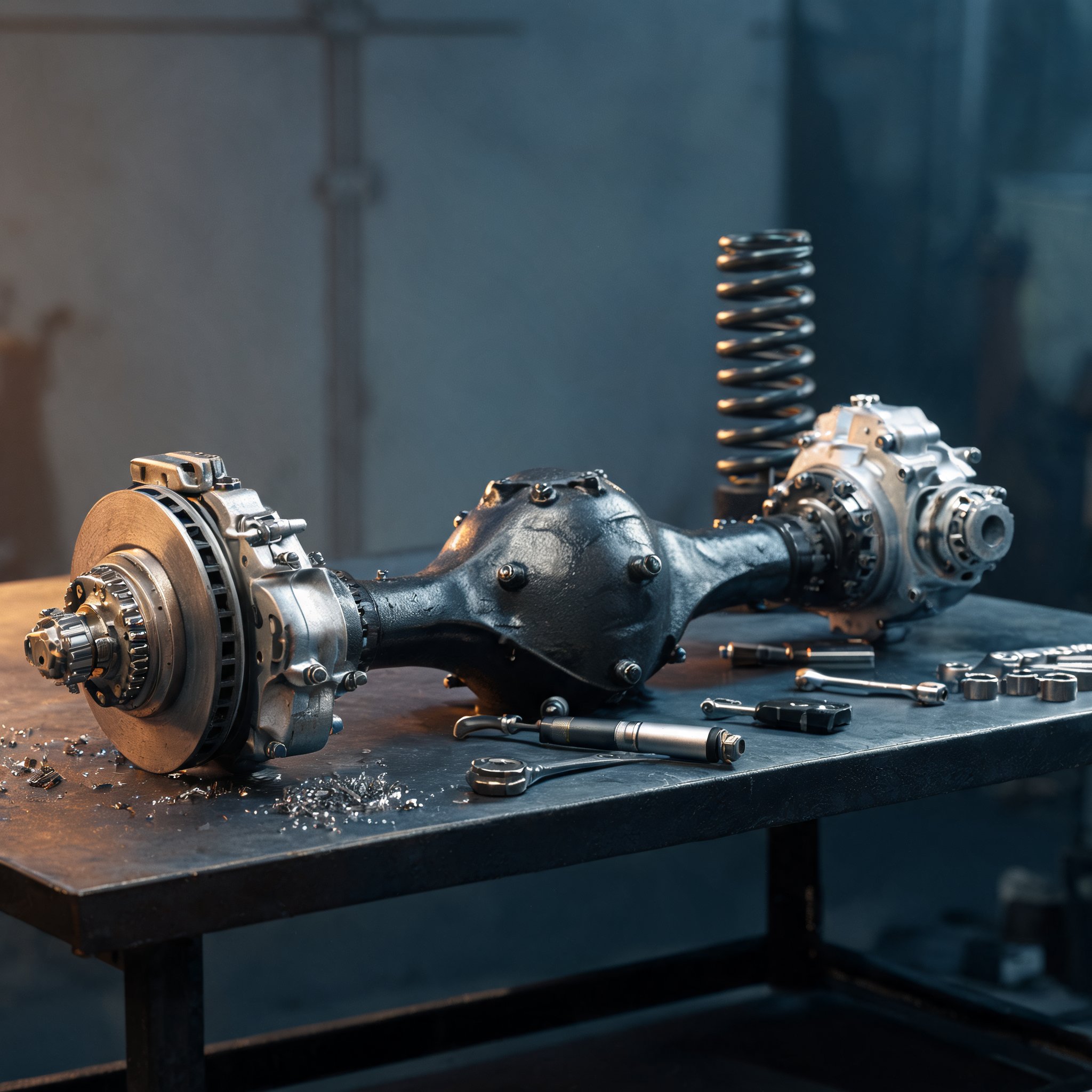
Portal axles are one of the most effective ways to make a four-wheeler taller and more capable off-road, but a typical set from outfits such as 74Weld runs around $20,000. Zeph Gage took a different route on his Jeep XJ: he built a portal axle for the rear only, at roughly a fifth of that price, using a Ford 9-inch axle housing, geared hubs from a Humvee and a set of Jesse Haines Fabrication HMMWV portal adapters.
What a portal axle actually does
Instead of letting axle shafts and other hardware hang below the transmission and transfer case, a portal axle places a stack of gears behind each driven wheel. That arrangement lets the axle shafts sit high, leaving very little hardware below the frame line. Combined with tall tires, it creates enough ground clearance for the vehicle to clear obstacles that would otherwise catch the underbody.
Turning low-pinion parts into a high-pinion unit
The Humvee hubs use two-gear portals, which reverse the direction of the input shaft's rotation. Gage dealt with that by flipping the Ford 9-inch differential upside down so the driveline spins the correct way, then bolting a Yukon Gear and Axle third member to it. The result is effectively a high-pinion unit assembled from low-pinion parts that have simply been turned on their head.
That inversion does more than add about six inches of clearance. According to the build, it also preserves full shock travel, which is difficult to achieve with portal axles, and reduces stress on the differential itself, making the assembly effectively bulletproof.
Why only the rear axle
Fitting a portal only at the back while keeping the front solid axle is a familiar trick in the remote-control rock crawler scene. By leaving the front end alone, Gage avoided the packaging constraints that tend to appear when portal axles are added to a vehicle that never came with them from the factory. He also did not have to limit shock travel to work around those constraints, and the ride height stays within reason rather than being pushed absurdly high.
The practical payoff is that the rear end no longer hangs up on obstacles the front end can simply steer around. Gage's XJ can reportedly drive over a five-gallon bucket and still have several inches of clearance to spare.
Not an off-the-shelf kit
This is not a bolt-on solution. The build required considerable custom fabrication, including homemade brackets, custom-tapped plates and a two-piece brake rotor paired with a Ford Fusion caliper. Gage chose the Fusion hardware partly because it offers an integrated electric emergency brake solenoid, and partly for clearance reasons.
Gage walked through the specifics, including how he matched gearing between the front and rear axles, in a video from Outdoor Auto.