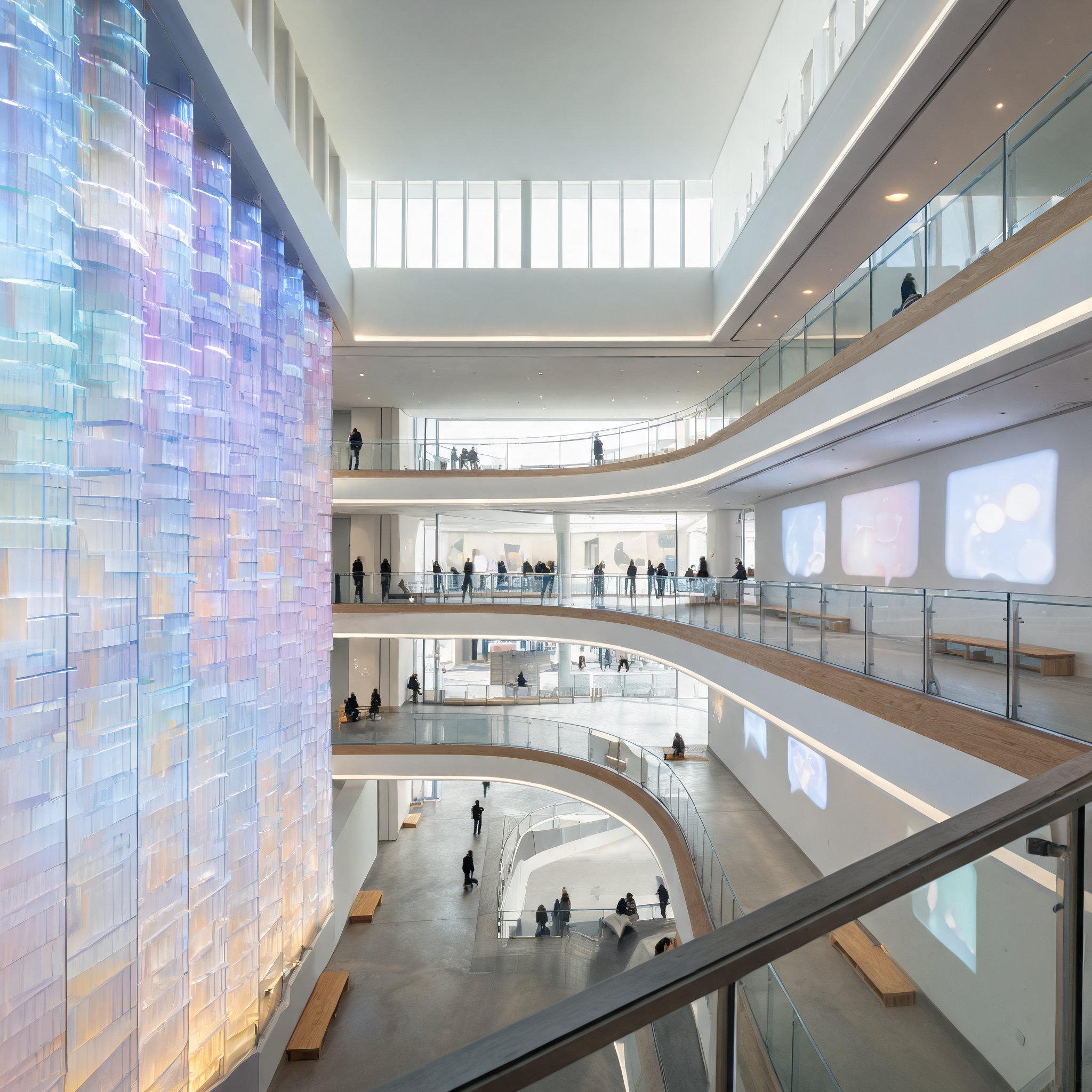
The Obama Presidential Center Museum, planned to open to the public on Juneteenth 2026 in Chicago's Jackson Park, will occupy four exhibition levels and nearly 35,000 square feet, with exhibition design by Ralph Appelbaum Associates and media production by batwin + robin Productions.
The museum is built around the story of President and Mrs. Obama — America's first Black president and First Lady — told as a journey through history, democracy, public service and the power of people to create change. Visitors are asked to weigh the promise and complexity of American democracy, the formative experiences that shaped the couple, the work of the Obama presidency, and the shared responsibility the institution frames as building a more perfect union.
Four levels, one civic arc
The route unfolds across four major exhibition levels: Toward a More Perfect Union, Working for the Common Good, The People's House and We the People. Together they carry visitors from the nation's founding ideals and unfinished work, through the people, movements, policies, challenges and accomplishments that shaped the Obama presidency, and into the civic questions of today and tomorrow. Artifacts, large-scale and immersive media, storytelling and hands-on digital and analog interactives are used throughout, with the stated aim of presenting democracy as a living practice shaped by ordinary people working together.
Media set pieces and the 2008 campaign
Among the anchor experiences is Power of Words, an 88-foot-tall media canvas that layers speech, sound, image, poetry and art to show how language can move people toward change. The opening gallery, Toward a More Perfect Union, is described as illuminated and prismatic, linking founding ideals and contradictions to the movements that have pushed American democracy toward greater justice and inclusion.
The Yes We Can Campaign circular gallery houses a panoramic media installation built around volunteer voices and crowd-sourced campaign objects, placing visitors inside the grassroots movement of 2008. Nearby, Democracy 101 is a hands-on civics exhibit that uses approachable interactive experiences to build knowledge, confidence and participation.
The presidency and the People's House
Panorama of a Presidency is a sweeping media room that surrounds visitors with a behind-the-scenes view of the activities and places that make up the daily work of the presidency. At a smaller scale, detailed miniature White House rooms offer an intimate look at how the Obamas opened the residence through traditions, celebrations, performances and public programs.
Life in the White House Artifacts assembles fashion, state gifts and sports memorabilia, presented as evidence of how the Obamas made the White House feel open, inclusive, personal and reflective of the country's diversity while upholding and expanding a range of traditions.
Interaction, commissions and access
Imagine Your Impact runs as a recurring interactive thread across all four levels, culminating in a shared media experience and a large-scale digital art commission intended to show how individual actions combine into collective change. Contemporary work is woven through the building: custom-designed benches by Norman Teague and commissioned pieces by Jeffrey Gibson, Jules Julien and María Magdalena Campos-Pons.
Inclusive design is treated as foundational rather than additive. The project describes multisensory and accessible provisions for visitors of all ages and abilities, from tactile stations and replicas to captioning, ASL interpretation, audio description, assistive listening, clear wayfinding and participatory interactives.
The exhibits place the Obamas' journey inside a broader civic narrative rooted in Chicago's South Side, shaped by national and global movements for justice, and carried forward by people still working for change in their communities, including participants in the Obama Foundation's Global Programs. The stated aim is that visitors leave with a deeper understanding of the Obamas' legacy and a renewed sense of their own agency in democratic work at home and abroad.