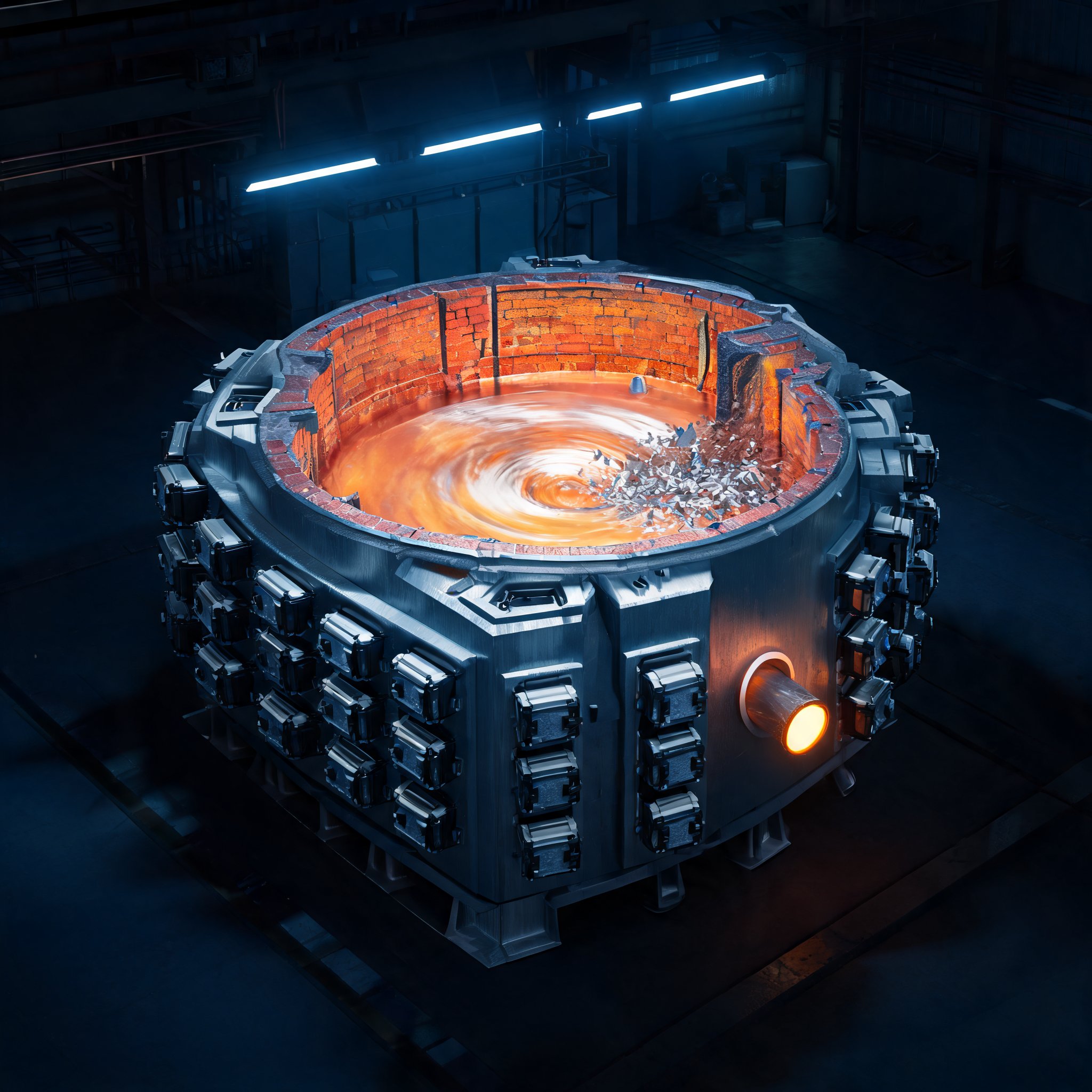
Aluminum casthouses are under pressure to run more post-consumer scrap without losing melt quality, recovery rates or production efficiency. Lightweight fractions and machining chips are the hardest materials to feed into conventional furnaces, and holding temperature and alloy chemistry uniform across the bath is just as demanding. Zmag America, Ltd. has built a product line around one answer to both: moving molten aluminum with a magnetic field instead of hardware immersed in the metal.
A magnetic circuit instead of an impeller
Zmag's roots are in industrial magnets and magnetic circuits, including commercialization of eddy-current separation for recovering non-ferrous metals from mixed streams. It later moved into molten-metal work, developing its patented zPMC (Zmag Permanent Magnetic Circuit) as the platform for equipment that stirs, circulates and submerges material in aluminum melts.
The distinction that matters is between permanent-magnet and conventional electromagnetic stirring. Instead of an electromagnetic stirring arrangement, zPMC uses a permanent magnetic circuit to generate the field that moves the metal. Zmag calls the resulting flow a virtual impeller: circulation without an immersed mechanical impeller.
The argument for that architecture starts with wear. Conventional mechanical pumps rely on immersed rotating parts that can deteriorate through exposure to molten aluminum, dross accumulation and contact with refractory debris. Removing the rotating part changes what must be maintained and what can contaminate the melt, while shifting the engineering burden onto the magnetic circuit itself.
MagStir: homogenization without contact
MagStir is a non-contact stirring system for melting and holding furnaces, offered in configurations for 15 to 200 metric ton furnaces. With no immersed stirring component, a casthouse can add circulation without another moving part in the molten-metal environment; the goal is consistent temperature and alloy composition through the bath.
The installation record extends beyond the United States. New Zealand Aluminium Smelters fitted the technology in a casting furnace and later extended it to other furnaces, and a 2017 technical case study reported improvements in temperature control during furnace preparation. Rio Tinto's Boyne Smelters in Queensland, Australia, added a MagStir unit to a casthouse furnace in 2019.
MagPump: circulation without a physical impeller
MagPump applies the same approach to pumping and circulation. It fits a standard pump well without furnace modification, uses no physical impeller, and is marketed as nearly hands-free, with no consumable parts and minimal downtime.
US secondary producer TST Inc. tested it at its TANDEM Division in Fontana, California, over seven weeks, replacing an existing mechanical pump on a production furnace. The reported findings describe smooth operation and less disturbance to the molten-metal surface, and plant management said the system avoided the splashing seen with conventional pumping as the metal level fell during draining.
The technology was also presented at TMS 2023, where its use in side-well, multi-chamber furnaces was discussed along with possible additional duties such as gas injection and scrap submergence.
Typhoon: getting light scrap under the surface
Typhoon targets scrap submergence and chip melting. Rather than letting light scrap and machining chips sit on top of the bath, its magnetic circuit generates a vortex-like movement that draws material below the surface into the melt, supporting heat exchange and recovery during remelting.
Neuman Aluminium's Marktl facility in Austria put that to work in a furnace modernization aimed at widening its ability to process low-density post-consumer scrap, including lightweight fractions with a bulk density of about 375 kg/m³ that had been hard to charge and melt conventionally.
Results came in above plan. Neuman had targeted one metric ton per hour while the same furnace kept melting solid charge; in operation the system processed almost twice the planned scrap quantity within the expected time, without disrupting normal furnace operation. The company reported low operator involvement and no negative effect on melt or finished-product quality.
The published technical account puts the system's power draw at 5 to 15 kW including its air-cooling blower, and its capacity at up to five metric tons per hour of machining chips. Vortex intensity is adjustable, so the unit can keep the bath moving when no scrap or alloying material is being charged.
A crowded field, not a like-for-like one
Several established suppliers serve furnace stirring, molten-metal circulation and scrap submergence, but their products are not all direct equivalents of a permanent-magnet system.
- ABB supplies its AL-EMS electromagnetic stirring system for melting, holding and alloying furnaces and reports more than 430 installations. In April 2026 it announced a further order from Arconic for a fifth stirrer at the company's Hungarian casthouse, following earlier units at the same site.
- Presezzi Extrusion Group, through its Melting Technology division and North American presence, offers the L.E.C. (Low Energy Consumption) Stirrer for melting and holding furnaces, alongside remelting equipment and complete casthouse installations.
- Pyrotek spans more of the casthouse: electromagnetic pump (EMP) systems that circulate molten aluminum and support metal transfer and scrap charging, and LOTUSS (Low Turbulence Scrap Submergence), which uses a circulation pump and refractory well to submerge light scrap. Its UK operations include EMP Technologies Ltd., which designs, sells and installs metal-melting and circulation systems built around electromagnetic pumps.
- Rockwell Automation sits in the adjacent industrial automation segment, supplying furnace and ladle-shop control systems such as its modernization work for Mozal Aluminium, rather than a competing stirring product.
Familiarity as the gating factor
In an August 2025 interview with AL Circle, Zmag America president Eishin Takahashi identified limited familiarity with the technology as a barrier to wider US adoption, saying producers globally tend to be conservative and to favor equipment and processes they already know.
What the record does and does not show
The case for non-contact metal movement grows as recycled feedstock gets more awkward: a furnace asked to absorb chips and low-density fractions needs circulation and a way to pull that material under. The reported results at NZAS, Boyne, TST and Neuman point that way.
The limits of the evidence deserve equal weight. The figures come from individual installations and company or conference accounts rather than a comparative trial across suppliers, and no energy, metal-loss or cost data are given for a head-to-head comparison with electromagnetic stirring or mechanical pumps. Whether permanent-magnet circuits prove more durable and less maintenance-intensive over multi-year campaigns remains an open question for casthouses weighing a switch.